Here's an interesting article from the Quartz website, titled "An Epic Battle in Streaming Music is About to Begin, and Only a Few Will Survive." I'll pause while you read and absorb.
This article is a fascinating examination of the current and coming changes in the music industry, vis a vis the shift from CDs to digital downloads to various types of streaming music services, from the business perspective. What I find really interesting -- no, kind of appalling -- is that the word "musician" is only used once in the article, and then only as a descriptor for an industry advocacy group. It's all about the business models, with no regard at all for the people who create what the industry politely refers to as "content."
The article bemoans "the costs of the content," in that the poor big streaming music companies are forced to pay royalties on the "content" they deliver. There must be a way to drive down these costs, argues the article, or else the poor big streaming music companies will never make any money. (The payments for "content," according to this article go to the "content owners" -- record labels and publishers. Not musicians, apparently.)
This, I argue, is today's problem in the music industry. The companies trying to make a buck off the music -- today, they're tech companies -- have no regard or affinity for the music itself. It's just "content" (of which "a large proportion of those songs are apparently never played"). It's not art, it's not inspirational, it's not personally touching -- it's just content for their customers to consume. Musicians are apparently nothing more than workers in a factory producing this anonymous content. It ain't the Beatles, it ain't Dylan, it ain't Nirvana, it's just "content," who cares where it comes from?
Putting tech companies like Google, Apple, and Spotify in charge of the musical art form is about as bad as it gets. At least the old school record labels actually recognized that they were selling music from musicians to people who loved music. To the tech companies, this is just another scheme to enlarge their portfolios, "control the Internet," and enhance their stock price. If it wasn't music, it'd be ball bearings or digital widgets or whatever.
And when these yahoos are done playing around in the music industry playground, they'll just move on to something else, leaving behind the rotting corpse of everything we love about music. The tech companies with their deep pockets won't even notice; the musicians with much less cash on hand will not be able to survive.
Wednesday, July 23, 2014

Friday, February 28, 2014
The Great Eight
Take a look at this:
Great Songwriters: Who Are They, and Why Haven't There Been Any for the Past 20 Years?
I just stumbled upon this very well reasoned and detailed blog post about songwriters, by Evert Cilliers (aka Adam Ash). Cilliers comes to the conclusion that there are only 8 great songwriters in the 20th century (Paul McCartney, Richard Rodgers, John Lennon, Jerome Kern, Bob Dylan, George Gershwin, Cole Porter, and Irving Berlin), but 200 almost-great ones, and no great ones writing today. I find his reasoning interesting, and agree with most of it. To get his "great eight" he focuses on quantity as much as quality.
With that reasoning, you can understand why McCartney and Rodgers come out on top. It makes perfect sense and it's tough to disagree with that. But this approach also relegates many worthy songwriters to the almost-great 200 list. For example, he looks at Jimmy Webb's output, finds only a half-dozen great songs, and says that's that. Now, I'd look at Webb's output and find a dozen great ones, but the quanity qualification still holds; Webb hasn't written near as many memorable tunes as Paul McCartney or George Gershwin or Irving Berlin.
Where Cilliers fails, IMHO, is with Bob Dylan and Burt Bacharach. He looks at Dylan and sees dozens and dozens of great songs. I look at Dylan and, while recognizing his tremendous influence he had on songwriting in the 1960s and beyond, only see a dozen or so truly great songs that have made it into the public consciousness. I have to look at the music as well as the lyrics, and Dylan is more of a lyricist than a composer. Also, even though the poster might like a large number of Dylan tunes, not that many (again, probably about a dozen) have made it into the lexicon and are well known to the general public.
Bacharach, on the other hand, truly is a great composer. (Not a lyricist, of course.) His melodies are legendary, he writes songs you can hum and remembers days and years later. And I can name several dozen Bacharach tunes that everybody and their brother knows, many more than I can name from Bob Dylan. Based on this combination of quantity and quality, that would put him in the great eight for me -- bumping Dylan, unfortunately.
But these are quibbles. I find this an interesting way to evaluate the songwriters of the 20th century, and admire the poster for comparing both pre- and post-rock songwriters, which is seldom done. You really can't argue much with his choices.
Anyone care to chime in?
Great Songwriters: Who Are They, and Why Haven't There Been Any for the Past 20 Years?
I just stumbled upon this very well reasoned and detailed blog post about songwriters, by Evert Cilliers (aka Adam Ash). Cilliers comes to the conclusion that there are only 8 great songwriters in the 20th century (Paul McCartney, Richard Rodgers, John Lennon, Jerome Kern, Bob Dylan, George Gershwin, Cole Porter, and Irving Berlin), but 200 almost-great ones, and no great ones writing today. I find his reasoning interesting, and agree with most of it. To get his "great eight" he focuses on quantity as much as quality.
With that reasoning, you can understand why McCartney and Rodgers come out on top. It makes perfect sense and it's tough to disagree with that. But this approach also relegates many worthy songwriters to the almost-great 200 list. For example, he looks at Jimmy Webb's output, finds only a half-dozen great songs, and says that's that. Now, I'd look at Webb's output and find a dozen great ones, but the quanity qualification still holds; Webb hasn't written near as many memorable tunes as Paul McCartney or George Gershwin or Irving Berlin.
Where Cilliers fails, IMHO, is with Bob Dylan and Burt Bacharach. He looks at Dylan and sees dozens and dozens of great songs. I look at Dylan and, while recognizing his tremendous influence he had on songwriting in the 1960s and beyond, only see a dozen or so truly great songs that have made it into the public consciousness. I have to look at the music as well as the lyrics, and Dylan is more of a lyricist than a composer. Also, even though the poster might like a large number of Dylan tunes, not that many (again, probably about a dozen) have made it into the lexicon and are well known to the general public.
Bacharach, on the other hand, truly is a great composer. (Not a lyricist, of course.) His melodies are legendary, he writes songs you can hum and remembers days and years later. And I can name several dozen Bacharach tunes that everybody and their brother knows, many more than I can name from Bob Dylan. Based on this combination of quantity and quality, that would put him in the great eight for me -- bumping Dylan, unfortunately.
But these are quibbles. I find this an interesting way to evaluate the songwriters of the 20th century, and admire the poster for comparing both pre- and post-rock songwriters, which is seldom done. You really can't argue much with his choices.
Anyone care to chime in?
Saturday, February 9, 2013
The Beatles
It was 49 years ago today when the Fab Four invaded America via their beachhead on the Ed Sullivan Show. I was one week shy of my sixth birthday, but I still remember my family hurrying home from a Sunday visit to my Uncle Ted's house in Elwood to catch whatever in the world everybody was talking about. Well, it was worth talking about, and helped defined popular music for generations to come.
I can't say that I was inspired to be a drummer by watching Ringo that night (as many doubtless were; my inspiration was Cubby on the Mickey Mouse Club), but it definitely had an impact. Watch it yourself to see why.
Monday, January 21, 2013
More on Amazon AutoRip
I recently wrote about Amazon AutoRip, which gives you free MP3 copies of any eligible CD you purchase from Amazon -- or have purchased in the past 15 years. Well, I purchase almost all my CDs from Amazon, and today received this email from them:
Dear Michael Miller, |
 logo, all songs
from the MP3 version of that album will instantly be delivered to your Amazon
Cloud Player library for FREE.
logo, all songs
from the MP3 version of that album will instantly be delivered to your Amazon
Cloud Player library for FREE.
There was also a link to view all of the 647 CDs mentioned. Pretty sweet, if you ask me.
Thursday, January 17, 2013
More Money
I've written before about the travails of the Minnesota Orchestra, whose musicians have now been locked out by management for more than 100 days. It's all because management wants the musicians to take a huge pay cut, in order to make the orchestra more profitable.
With that as background, I found the following somewhat incredible -- meaning, literally, it strained credibility. Last night, at dinner time, I fielded a call from the Minnesota Orchestra. (Not the musicians, but the management.) They were looking for me to contribute a little something something to their endowment fund. I gave the poor phone solicitor an earful about me supporting the musicians not the management, to which I got a continuation of the spiel, to which I said I wouldn't talk to them again until the musicians were paid what they're worth and hung up the phone.
End of story, until I got this follow-up email today. The gall of these people, begging for money while they lock out the musicians that make the Minnesota Orchestra great.
Here's the email:
With that as background, I found the following somewhat incredible -- meaning, literally, it strained credibility. Last night, at dinner time, I fielded a call from the Minnesota Orchestra. (Not the musicians, but the management.) They were looking for me to contribute a little something something to their endowment fund. I gave the poor phone solicitor an earful about me supporting the musicians not the management, to which I got a continuation of the spiel, to which I said I wouldn't talk to them again until the musicians were paid what they're worth and hung up the phone.
End of story, until I got this follow-up email today. The gall of these people, begging for money while they lock out the musicians that make the Minnesota Orchestra great.
Here's the email:
Dear Mr. Miller,
Thank you for taking the time to speak with a Minnesota Orchestra Phone Representative regarding the Building for the Future campaign.
The Campaign is poised to accomplish much more than capital improvements – our goal is to raise $30 million to help revitalize the current endowment. This important resource will ensure the continued growth of our artistic success and our financial viability, maintaining the Minnesota Orchestra as a source of inspiration for individuals of all ages for many generations to come.
If you would like to learn more about this important initiative, please visit our campaign site. Again, thank you for your time.
Sincerely,Can you believe that? They want dissatisfied customers (excuse me, patrons) to contribute even more to their management coffers, even as we're deprived of music from our esteemed musicians. What a way to run a railroad...
Jessica Rau
Campaign Manager
Friday, January 11, 2013
Amazon AutoRip
Here's something cool, at least sort of. Amazon is introducing a new AutoRip service, which provides MP3 versions of selected CDs you purchase. Look for the blue/green AutoRip icon on new CD product pages; as soon as you purchase the CD, you also have access to MP3 versions of all the tracks, at no extra charge. These MP3 tracks are automatically added to your Amazon Cloud Player library, and can then be downloaded to your computer. The AutoRip tracks don't count towards your Cloud Player storage limits, either.
Even better, if you've purchased any CD from Amazno currently identified as AutoRip anytime in the past 15 years (since 1998), you get MP3 versions of those CDs for free, too. Kind of cool -- an added feature for past purchases. Good job, Amazon!
On the downside, we are are talking about MP3 files here, not lossless AAC or WMA. They're ripped at 256Kbps, which isn't horrible but could be better. And not every CD available has AutoRip capability; at present, only 50,000 CDs are available with AutoRip.
Still and all, a very nice way to build your digital library while still purchasing physical CDs. Learn more about AutoRip here.
Even better, if you've purchased any CD from Amazno currently identified as AutoRip anytime in the past 15 years (since 1998), you get MP3 versions of those CDs for free, too. Kind of cool -- an added feature for past purchases. Good job, Amazon!
On the downside, we are are talking about MP3 files here, not lossless AAC or WMA. They're ripped at 256Kbps, which isn't horrible but could be better. And not every CD available has AutoRip capability; at present, only 50,000 CDs are available with AutoRip.
Still and all, a very nice way to build your digital library while still purchasing physical CDs. Learn more about AutoRip here.
Wednesday, January 9, 2013
Does Quality Matter?
I am saddened by the fact that so many people settle for low-quality digital recordings played on sub-hi fidelity equipment, such as the speakers in your average notebook computer. And I am further saddened by how many people don't really listen to music anymore, but just use it for background noise. All this is addressed in Steve Guttenberg's recent CNET column, "At What Point Does Lousy Sound Interfere with Enjoying Music?"
I find the comments to his article even more interesting. Like this one:
I find the comments to his article even more interesting. Like this one:
"Yes it's nice to hear great sounding music, but to me it's mostly background. I don't have that "oh my god, bluetooth sound, I'd rather hear nothing" attitude. I'll bet they believe gold plated digital connectors actually improve the sound quality."Like I said, it saddens me. The days of having a few friends over to actually listen to a new album (and pass around the album cover, too) are long gone, apparently.
Friday, January 4, 2013
Music Sales
According to this article, 2012 music sales (revenues) were up 3.1%. However, individual track/album purchases (units) were down 1.8%. So people are buying slightly fewer items at slightly higher prices.
These numbers do not reflect royalties/licenses/whatever from digital music subscription services, such as Spotify, Pandora, and SiriusXM. Given the apparent shift from individual item sales/downloads to streaming subscriptions, this could be a big number. So things don't look so bad.
In specific detail, physical albums (CDs) remain the single largest format, even with a 12.8% decrease in unit sales. Digital album sales increased 14% and sales of individual digital tracks increased 5%. Those are smaller increases from past years, probably reflecting the shift to digital music streaming services.
These numbers do not reflect royalties/licenses/whatever from digital music subscription services, such as Spotify, Pandora, and SiriusXM. Given the apparent shift from individual item sales/downloads to streaming subscriptions, this could be a big number. So things don't look so bad.
In specific detail, physical albums (CDs) remain the single largest format, even with a 12.8% decrease in unit sales. Digital album sales increased 14% and sales of individual digital tracks increased 5%. Those are smaller increases from past years, probably reflecting the shift to digital music streaming services.
Friday, December 7, 2012
My Brubeck Remembrances
Legendary jazz pianist and composer Dave Brubeck passed away on December 5th, one day shy of his 92nd birthday. It's gratifying to me how much Facebook and Twitter chatter has accompanied this event, virtually all praising Brubeck's music and many relaying personal remembrances associated with Mr. Brubeck and his tunes.
To that end, a few remembrances of my own.
 My first encounter with Brubeck's music was back in 1972, when I was in 8th grade. I'd been taking drum lessons for three years or so, and my instructor, Jack Wagley, had just got me started on Joe Morello's New Directions in Rhythm book, which was all about playing in 3/4 and 5/4 time. I was doing fine with the 3/4 studies but not really swinging the 5/4 stuff. So Jack suggested (no, demanded) that I listen to some Dave Brubeck Quartet stuff, "Take Five" specifically. So I called up my dad and asked him to stop in at the local Lyric Records on his way home from work and pick up any Brubeck album with "Take Five" on it. He ended up bringing home a copy of Dave Brubeck's Greatest Hits, which I immediately put on the old GE hi-fi and played the heck out of. I was hooked.
Well, the very next day after I got that first Brubeck LP, I was leaving my morning choir class when my choir teacher, Mrs. Earnshaw (I know her now as Phyllis Fulford) asked if I'd be interested in getting together some afternoons after school to "play a little Brubeck" with her on piano, band teacher Gene Smith on alto sax, and my ninth-grade friend Brian Siemers on bass. THE VERY NEXT DAY it was. Fortuitous. Of course, I said yes. The four of us put together a fairly good facsimile of the Brubeck Quartet, Mr. Smith had a nice light touch in the Desmond mold, Brian and I locked in the rhythm like we'd been doing it all along, and I even got to throw in my best Morello chops on the requisite "Take Five" drum solo. It was a blast, and we ended up playing "Take Five" at a Choral Club concert later that spring. I don't know who to thank, Phyl or my drum teacher or the unseen hand of fate, but that whole experience got me tuned into jazz in general and Brubeck in particular. And I can still swing the hell out of 5/4, thank you very much.
A little later that year the Brubeck Quartet came to town for an outdoor concert at the Indianapolis Museum of Art, and Phyl and Brian and I snapped up tickets. It wasn't the "classic" Quartet; Desmond, Morello, and Wright were gone, replaced (if my memory serves me correctly) by Gerry Mulligan (bari sax), Alan Dawson (drums), and Jack Six (bass). But the concert was fantastic, and I even got talked into getting Brubeck's autograph for Phyllis, who was too shy or embarrassed or whatever to do it herself. This visit coincided with a clinic by Alan Dawson at Fred's Drums, the big local drum shop of the time, which was another fine learning experience. Heady times.
I listened to Brubeck pretty continuously over the years, but never got another chance to catch him in concert until a couple of years ago, after I'd moved up to the Twin Cities. He was playing with his long-standing current Quartet, with Bobby Militello on sax, Randy Jones on drums, and Michael Moore on bass. Brubeck himself was 89 years old, needed assistance getting to and from the piano, but played just as strongly as he had forty years before. It was a privilege to listen to the man play, a true joy.
And now, two years later, Dave Brubeck has left us. His music, however, remains, and remains a considerable influence on the worlds of both jazz and popular music. Brubeck was a unique pianist, with his dense block chords punctuating the music in unexpected rhythms, while at the same time supporting his sweetly lyrical melodic lines. He was a very intelligent player, applying tons of advanced theory to even the simplest tunes; his own compositions were intricate and thoughtful, things of joy and beauty.
The world remembers Dave Brubeck for "Take Five," and that's fair, even if it wasn't his composition (Paul Desmond wrote it after hearing Joe Morello do some warm ups in five) and even if he didn't have a solo on it. But it was representative of his repertoire, cool and intelligent yet still swinging -- just like the man himself.
Dave Brubeck will be missed, of course, but will be remembered -- and will also be the key to other great memories. Thanks, Mr. Brubeck. You deserve a big time out.
To that end, a few remembrances of my own.
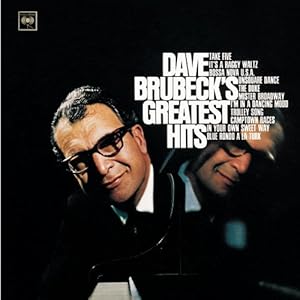
Well, the very next day after I got that first Brubeck LP, I was leaving my morning choir class when my choir teacher, Mrs. Earnshaw (I know her now as Phyllis Fulford) asked if I'd be interested in getting together some afternoons after school to "play a little Brubeck" with her on piano, band teacher Gene Smith on alto sax, and my ninth-grade friend Brian Siemers on bass. THE VERY NEXT DAY it was. Fortuitous. Of course, I said yes. The four of us put together a fairly good facsimile of the Brubeck Quartet, Mr. Smith had a nice light touch in the Desmond mold, Brian and I locked in the rhythm like we'd been doing it all along, and I even got to throw in my best Morello chops on the requisite "Take Five" drum solo. It was a blast, and we ended up playing "Take Five" at a Choral Club concert later that spring. I don't know who to thank, Phyl or my drum teacher or the unseen hand of fate, but that whole experience got me tuned into jazz in general and Brubeck in particular. And I can still swing the hell out of 5/4, thank you very much.
A little later that year the Brubeck Quartet came to town for an outdoor concert at the Indianapolis Museum of Art, and Phyl and Brian and I snapped up tickets. It wasn't the "classic" Quartet; Desmond, Morello, and Wright were gone, replaced (if my memory serves me correctly) by Gerry Mulligan (bari sax), Alan Dawson (drums), and Jack Six (bass). But the concert was fantastic, and I even got talked into getting Brubeck's autograph for Phyllis, who was too shy or embarrassed or whatever to do it herself. This visit coincided with a clinic by Alan Dawson at Fred's Drums, the big local drum shop of the time, which was another fine learning experience. Heady times.
I listened to Brubeck pretty continuously over the years, but never got another chance to catch him in concert until a couple of years ago, after I'd moved up to the Twin Cities. He was playing with his long-standing current Quartet, with Bobby Militello on sax, Randy Jones on drums, and Michael Moore on bass. Brubeck himself was 89 years old, needed assistance getting to and from the piano, but played just as strongly as he had forty years before. It was a privilege to listen to the man play, a true joy.
And now, two years later, Dave Brubeck has left us. His music, however, remains, and remains a considerable influence on the worlds of both jazz and popular music. Brubeck was a unique pianist, with his dense block chords punctuating the music in unexpected rhythms, while at the same time supporting his sweetly lyrical melodic lines. He was a very intelligent player, applying tons of advanced theory to even the simplest tunes; his own compositions were intricate and thoughtful, things of joy and beauty.
The world remembers Dave Brubeck for "Take Five," and that's fair, even if it wasn't his composition (Paul Desmond wrote it after hearing Joe Morello do some warm ups in five) and even if he didn't have a solo on it. But it was representative of his repertoire, cool and intelligent yet still swinging -- just like the man himself.
Dave Brubeck will be missed, of course, but will be remembered -- and will also be the key to other great memories. Thanks, Mr. Brubeck. You deserve a big time out.
Monday, November 26, 2012
Crooked Management
More on the Minnesota Orchestra issues. This article proves it -- orchestra management cooked the books to make things look better when they were asking for corporate donations to redo Symphony Hall, then cooked them again to make things look worse when it was time to renegotiate the musician's contract. Also, a very explicit desire to "reset the business model." Here's the relevant quote:
"Balances in 2009 and 2010 would support our state bonding aspirations," Bryan Ebensteiner, vice president of finance, told the orchestra's executive committee in September 2009, "while the deficits in 2011 and 2012 would demonstrate the need to reset the business model."
What a bunch of lying, backstabbing, unappreciative crooks. These people should not be involved in any artistic endeavor in our community. The orchestra board should be deposed.
"Balances in 2009 and 2010 would support our state bonding aspirations," Bryan Ebensteiner, vice president of finance, told the orchestra's executive committee in September 2009, "while the deficits in 2011 and 2012 would demonstrate the need to reset the business model."
What a bunch of lying, backstabbing, unappreciative crooks. These people should not be involved in any artistic endeavor in our community. The orchestra board should be deposed.
Wednesday, November 21, 2012
Best Demo Music
CNET's "Audiophiliac" Steve Guttenberg has laid out his top albums for demoing speakers and headphones. (Here's his list.) As I don't own most of the albums on his list, I can't confirm or object, but of the two albums I do own (Holly Cole's Temptation and Rosanne Cash's Ten Song Demo), I'd say they're good choices.
A while back I put together an "audiophile playlist" that contains the tracks I use to show off my own system. Here's what's on the playlist, in no certain order:
I also put Steely Dan's Aja and Al Stewart's Year of the Cat up there on my demo list, although they're not quite the audiophile quality as the rest of the list. (Aja comes very, very close, however.) Any of these tracks will give you immense sonic pleasure; they're all beautifully and lovingly recorded, without a lot of excess splash and woohoo. Just great music, recorded well.
A while back I put together an "audiophile playlist" that contains the tracks I use to show off my own system. Here's what's on the playlist, in no certain order:
- "The Look of Love," Dusty Springfield, Casino Royale. This soundtrack to the 1960s movie, with music by Burt Bacharach, has long been an audiophile's delight. Dusty's vocals on this track are just so close and breathy, you really get the feeling she's sitting right beside.
- "Don't Know Why," Norah Jones, Come Away with Me. More tight breathy vocals. Doesn't get much better than this.
- "I Don't Like Mondays" and "Time," Tori Amos, Strange Little Girls. Very upfront vocals, great presence.
- "Written on the Back of His Hand" and "Song for Molly," Lucy Kaplansky, Every Single Day.
- "Priscilla," Suzanne Vega, Songs in Red and Gray. Chest-thumping bass drum.
- "Stockings," Suzanne Vega, Nine Objects of Desire.
- "Brothers in Arms" and "Why Worry," Dire Straits, Brothers in Arms. Terrific (and terrifically recorded) guitar work from the legendary Mark Knopfler.
- "You're a Big Girl Now" and "Simple Twist of Fate," Bob Dylan, Blood on the Tracks. Some of the best recorded acoustic guitar work ever.
- "Round Here," Counting Crows, August and Everything After. Really. Just listen to it.
- "Love Turns 40," Vienna Teng, Dreaming Through the Noise.
- "Walk Away Renee," Linda Ronstadt and Ann Savoy, Adieu False Heart.
- "New Favorite" and "Let Me Touch You For Awhile," Alison Krauss & Union Station, New Favorite. It's like they're playing in your living room.
- "Jericho," Joni Mitchell, Don Juan's Reckless Daughter. Bass by the late great Jaco Pastorius.
- "The First Five Chapters," Dianne Reeves, In the Moment: Live in Concert.
- "The Music That Makes Me Dance," Shirley Horn, You Won't Forget Me.
- "Peel Me a Grape," Nancy Wilson and Ramsey Lewis, Meant to Be.
- "Twentysomething," Jamie Cullum, Twentysomething.
- "Spring is Here," Charlie Haden and Kenny Barron, Night and the City. Intimate jazz, terrific acoustic bass.
- "Fascinating Rhythm," Dave Grusin, The Gershwin Collection.
- "Some Other Time," Gary Burton and Ralph Towner, Matchbook. Vibes and acoustic guitar. Wow.
- "Electronic Performers," Air, 10,000Hz Legend. Powerful electronics.
- Carmen Fantasie, op. 25, Ruggerio Ricci and the London Symphony Orchestra, Carmen Fantasie/Havanaise
- V: Saturn, the Bringer of Old Age (Adagio), Zubin Mehta and Los Angeles Philharmonic, Holst: The Planets
I also put Steely Dan's Aja and Al Stewart's Year of the Cat up there on my demo list, although they're not quite the audiophile quality as the rest of the list. (Aja comes very, very close, however.) Any of these tracks will give you immense sonic pleasure; they're all beautifully and lovingly recorded, without a lot of excess splash and woohoo. Just great music, recorded well.
Tuesday, November 13, 2012
Changing the (Orchestra) Model
It's becoming quite obvious to me that Minnesota Orchestra management does not see individual musicians as having unique value. Instead, it regards musicians as interchangeable parts. Why bother paying Pinchas Zukerman top dollar when any young violinist fresh out of music school can play the same notes?
What the MO management really is trying to do is to change the model for the entire orchestra, from a world-class artistic ensemble to a (perhaps) more profitable pops orchestra. The ultimate goal in these contraction "negotiations" is to force out the higher-paid cogs in the machine and replace them with lower-paid, less experienced musicians. Reduce the payroll, reduce the reliance on well-known, higher-paid individuals, and you make more money -- especially if the new guys spend most of their time playing pop concerts instead of more challenging classical pieces.
This is a drastic re-imagining of one of the world's top orchestras, and it's being done with zero transparency and zero input from the community to which the orchestra serves. If management succeeds, they may end up killing this highly regarded artistic organization and replacing it with a less-regarded, more generic pop ensemble of undistinguished players.
What the MO management really is trying to do is to change the model for the entire orchestra, from a world-class artistic ensemble to a (perhaps) more profitable pops orchestra. The ultimate goal in these contraction "negotiations" is to force out the higher-paid cogs in the machine and replace them with lower-paid, less experienced musicians. Reduce the payroll, reduce the reliance on well-known, higher-paid individuals, and you make more money -- especially if the new guys spend most of their time playing pop concerts instead of more challenging classical pieces.
This is a drastic re-imagining of one of the world's top orchestras, and it's being done with zero transparency and zero input from the community to which the orchestra serves. If management succeeds, they may end up killing this highly regarded artistic organization and replacing it with a less-regarded, more generic pop ensemble of undistinguished players.
Sunday, November 11, 2012
Digital Music in Windows 8
I've been using and writing about Windows 8 for some time now, for my two books Absolute Beginner's Guide to Computer Basics, Windows 8 Edition, and Easy Computer Basics, Windows 8 Edition. I just now got around to upgrading my aging Niveus media center PC to Windows 8, however, so I can now speak to the Windows 8 experience for digital music in the living room.
First, about the upgrade. My Niveus Denali HTPC is getting a little long in the tooth. I'm pretty sure it dates back to 2005 or so, but in 2008, following a massive system failure, the good folks at Niveus put in a new motherboard and other internals, free of charge. So let's call it a 2008 model, still four years old, still running Windows Vista.
The upgrade went relatively smoothly. The only big issue was that, post-upgrade, Windows couldn't find my sound card or install proper drivers. Fortunately Brian Paper at Niveus helped me out by identifying the proper sound card and a link to the drivers; got the drivers installed and everything worked good as new. Better than new, actually, as Windows 8 is much, much zippier on older machines than Windows Vista was. Feels kind of like a new system.
(Kudos to Brian and the guys at Niveus for their continued assistance and support -- which they really don't need to do, as Niveus quit making PCs about two years ago. Now they focus on providing digital media solutions for various consumer and commercial markets; no more of those uber expensive, ultra quiet, high-end HTPCs, which I miss.)
Anyway, one of the questions I had was whether the default Win8 Music app (recently renamed to Xbox Music) would suffice for living room use. Quick answer? Nope. I thought the big-tiled interface would work well as a ten-foot interface, but that's not the case; navigation gets in the way. I can use my Logitech remote control to move left or right (or up or down) through the individual tiles, but not from one tile group to another on the Music screen. And, since Microsoft insists on starting Music on the Now Playing section, leading to the All Music section (the focus is on purchasing music, not playing your own), it's difficult if not impossible to move backwards to the My Music section to access my own digital music collection. Even when you get into the My Music section, the album display is much, much too small for living room use. Let's face it; Win8 is designed primarily for up-close tablet use, is somewhat usable on a standard desktop or notebook PC, but doesn't cut it as a living room media center interface.
Which means it's back to Windows Media Center. If you're into digital media at all, you probably know that Microsoft has ceased future development of WMC and even removed it from the base version of Windows 8. But MS still makes WMC available as an add-on for Win8 users, and it's actually free until the end of the year. (Go here to learn how to download WMC for Win8.)
So after I upgraded to Win8 I downloaded my free version of Windows Media Center. It's essentially the same WMC that was in Windows 7, which is a small improvement over the one I was using in Windows Vista. There were a handful of useful changes that I noted, including the following:
First, about the upgrade. My Niveus Denali HTPC is getting a little long in the tooth. I'm pretty sure it dates back to 2005 or so, but in 2008, following a massive system failure, the good folks at Niveus put in a new motherboard and other internals, free of charge. So let's call it a 2008 model, still four years old, still running Windows Vista.
The upgrade went relatively smoothly. The only big issue was that, post-upgrade, Windows couldn't find my sound card or install proper drivers. Fortunately Brian Paper at Niveus helped me out by identifying the proper sound card and a link to the drivers; got the drivers installed and everything worked good as new. Better than new, actually, as Windows 8 is much, much zippier on older machines than Windows Vista was. Feels kind of like a new system.
(Kudos to Brian and the guys at Niveus for their continued assistance and support -- which they really don't need to do, as Niveus quit making PCs about two years ago. Now they focus on providing digital media solutions for various consumer and commercial markets; no more of those uber expensive, ultra quiet, high-end HTPCs, which I miss.)
Anyway, one of the questions I had was whether the default Win8 Music app (recently renamed to Xbox Music) would suffice for living room use. Quick answer? Nope. I thought the big-tiled interface would work well as a ten-foot interface, but that's not the case; navigation gets in the way. I can use my Logitech remote control to move left or right (or up or down) through the individual tiles, but not from one tile group to another on the Music screen. And, since Microsoft insists on starting Music on the Now Playing section, leading to the All Music section (the focus is on purchasing music, not playing your own), it's difficult if not impossible to move backwards to the My Music section to access my own digital music collection. Even when you get into the My Music section, the album display is much, much too small for living room use. Let's face it; Win8 is designed primarily for up-close tablet use, is somewhat usable on a standard desktop or notebook PC, but doesn't cut it as a living room media center interface.
Which means it's back to Windows Media Center. If you're into digital media at all, you probably know that Microsoft has ceased future development of WMC and even removed it from the base version of Windows 8. But MS still makes WMC available as an add-on for Win8 users, and it's actually free until the end of the year. (Go here to learn how to download WMC for Win8.)
So after I upgraded to Win8 I downloaded my free version of Windows Media Center. It's essentially the same WMC that was in Windows 7, which is a small improvement over the one I was using in Windows Vista. There were a handful of useful changes that I noted, including the following:
- New Now Playing screen, with small thumbnails of album covers in the background. I kind of like it, but my wife thinks it's too busy.
- New Now Playing controls after you make a selection. Smaller text, but more options. I give it a wash.
- New "play pictures" option from the Now Playing screen, launches a completely different photo slideshow than the standard slideshow in the Photos section. Looks like it grabs all photos at random from the My Photos folder, as opposed to any selected subfolder. I like it.
- New ability to play all albums/tracks released in a given year. I really like this.
- Appears to have fixed the old Vista bug that downgraded all album artwork to 300 x 300 pixels.
And just a slightly snazzier interface throughout, with hipper fonts. Always nice to put a fresh coat of paint on the old house.
By the way, the potential issue of not being able to boot directly into WMC is an issue, but not a major one. Windows 8 always, always, always boots into the hated Start screen; you can't boot to the Desktop or to Media Center. But one push of the "green button" on the remote control launches WMC and displays it front and center. Turns out not to be a big deal, and I have to deal with the Win8 Start screen not much at all.
By the way, the potential issue of not being able to boot directly into WMC is an issue, but not a major one. Windows 8 always, always, always boots into the hated Start screen; you can't boot to the Desktop or to Media Center. But one push of the "green button" on the remote control launches WMC and displays it front and center. Turns out not to be a big deal, and I have to deal with the Win8 Start screen not much at all.
The big news, however, is how much faster the entire system runs under Windows 8. No more interminable pauses before playing music after a restart. Much, much faster booting. More responsive menus. Fewer little playback quirks. Just runs better. Well worth the $39 upgrade price.
I'll talk more about the Xbox Music app in a future post. At this juncture I'm not overwhelmingly impressed, but we'll see.
Sunday, October 28, 2012
Those Darned Canadians!
Take a read of this article about the Toronto Symphony Orchestra, which played this past season at a slight deficit and is ready to renegotiate musicians' contracts without asking for a cut in payroll. The approach of the Toronto Symphony Orchestra management is in direct contrast to that of the Minnesota Symphony and many other American orchestras. Those darned Canadians want to produce the best possible music they can, and know that that will attract audiences (and donations). What a concept!
I think most American businesses can learn something from Toronto's CEO: "I’m trying to increase the compensation to musicians so that we can attract the best and reward them for great performances." That's right. Pay more to get the best employees, and good things will happen. As an old boss of mine used to say, you can't save your way to prosperity. You have to spend a little get the best people, and the best people will deliver the best results. Period.
Monday, October 22, 2012
More Orchestra Troubles
It's happening again, this time across the river in St. Paul. The St. Paul Chamber Orchestra, asked to take a 33% pay cut (and cut number of musicians and performing weeks) has been locked out by management. A very sad time for the state of music in the state of Minnesota, and across the nation. Read more here.
Thursday, October 18, 2012
How to Kill an Orchestra
More details are coming to light about management's offer to the musicians of the Minnesota Orchestra. Read more details here, from Robert Levine at the Polyphonic.org. It's sickening.
Levine reports that the musicians' yearly base salary is set to decrease from $111,566 to $77,896. Do the math; that's a 30% pay cut. (Some musicians earn more, based on titled chairs and seniority and such, but this what the typical musician takes home.) Again, I ask -- how would you react to your employer asking you to take a 30% cut in pay? Could you pay your bills if you were taking home a third less than you are now?
It gets even worse for extras and subs. (Extras are just that, extra musicians necessary to perform certain pieces; subs are substitutes for regular player who are on vacation, out sick, or otherwise absent for a given performance.) Currently, extras and subs earn the same pay as do the regular players. Under management's proposal, subs and extras not only have to suffer the same 30% pay cut as do regular players, but an addition 25% pay cut beyond that. That reduces their paycheck from the current $2,144 per week to $1,123 per week. That's cutting their pay almost in half.
(BTW, if you think extras and subs should be paid less than regular players, you don't know how this whole orchestra thing works. Extras and subs do the same work as regular players while they're there, but with an added degree of difficulty, especially for subs. A sub might get a call in the morning to report for rehearsals that afternoon, and then have to sightread music they've never seen or played before. I have a lot of respect for these non-regular players, and know that they're worth every penny they're paid. Read this blog post by sub violinist Jill Olson Moser to gain a fuller appreciation of this particular role.)
There's more to it than just the money, but geez, this is horrific. It's especially appalling when you realize that management is asking musicians to take this kind of pay cut at the same time the Orchestra is doing a $50 million renovation to Orchestra Hall. I'd rather stick with the current lobby and such than lose any of the talented musicians who play the music we love. It's a real slap in the face.
Also a slap in the face is the salary of Michael Henson, the Orchestra's President and CEO. Henson's current salary is $404,000 (up from $390,000 three years ago), and near as I can tell he's not taking any pay cut. (In case you're wondering, his salary is 1.5 times the average for that position in similarly sized non-profit organizations.) How can Henson justify his outrageous salary while asking the musicians who create the music to cut theirs by 30%?
Some observers are speculating that his is all a grand ruse by Henson and the rest of management to simply cancel the entire season that the Orchestra is playing outside of the under-renovation Orchestra Hall. The replacement venue is the Convention Center, which is less than ideal -- and, for all I know, might be more expensive than their normal environs. Heck, it's also possible that subscriptions and ticket sales are down for this out-of-Hall season. Rather than suffer lost revenues for this season, why not lock the musicians out and call the entire season a loss? I don't know if this is really the case, but it's certainly plausible.
This situation is unacceptable. If finances are really this bad, then cancel the expensive renovations, slash the CEO's exorbitant salary, and do whatever else is necessary to keep paying the musicians what they're worth. Since none of these other measures are even under consideration, this looks to be exactly what it is -- a frontal attack on some of the most talented musicians in this country.
If management gets their way, many of these players will simply leave for more acceptable positions elsewhere. Is that what we as an arts-loving community want? I don't think so.
I'm not sure what we can do for the musicians right now except voice our support for them and our discontent with Michael Hanson and Orchestra management. If this ends up as badly as it could, the Orchestra will lose a lot of community support -- and ticket sales. Do you really want to give your hard-earned entertainment dollars to the insensitive management creeps who want to punish the fine musicians of the Minnesota Orchestra? I certainly don't, and I won't.
It's that simple. Push through these draconian pay cuts and they'll kill the Minnesota Orchestra as we know it. Let's hope that doesn't happen.
Wednesday, October 17, 2012
ISO Settles
It looks like the Indianapolis Symphonic Orchestra musicians have settled with management, but at a horrific cost. (Read the details here.) First, there's a 32% pay cut, with the average salary decreasing from $78,000 to $53,000. (There are yearly increases baked into the five-year contract that bring that back up to $70,000 in year five, but still -- how would you like your paycheck cut by a third? And $53,000 is a pretty lousy salary for world-class musicians, don't you think?) Second, the ISO is no longer one of the country's 18 full-year orchestras; the season is now going to be 38 to 42 weeks.
Frankly, these terms place the ISO more in the mode of a community orchestra than a professional one. That's a shame; the orchestra could have been (and was) a whole lot more. Let's hope that orchestral musicians elsewhere (such as in the Twin Cities) don't have to sacrifice so much.
You know, this never would have happened to a professional sports team.
Frankly, these terms place the ISO more in the mode of a community orchestra than a professional one. That's a shame; the orchestra could have been (and was) a whole lot more. Let's hope that orchestral musicians elsewhere (such as in the Twin Cities) don't have to sacrifice so much.
You know, this never would have happened to a professional sports team.
Tuesday, October 16, 2012
Bye Bye Sqeezebox
CNET reports that Logitech has discontinued the Squeezebox line of products. That's too bad; the Squeezebox was a nice option for digital music lovers. It's also a bummer if you're a current Squeezebox owner, as there's no indication how or how long Logitech will be supporting you. I think it's another case where everyone's focusing on video and ignoring the audio-only options. C'est la vie.
 In related news, Logitech's new UE Smart Radio looks to take the place of the old Squeezebox Radio. You can use it to stream audio from a variety of music services (including Spotify and Pandora), as well as all the digital music you've stored on your personal computer. It runs $179.99, and operates off wall power or (for six hours) its own internal batteries. You control it with an iOS or Android app on your smartphone. Not a bad deal if you need an all-in-one music player for one of the rooms in your house.

Tuesday, October 2, 2012
Orchestra Troubles
For classical music lovers, some disturbing news headlines:
- Minnesota Orchestra's Fall Performances Wiped Out with Lockout
- St Paul Chamber Orchestra Managers Reject Union Contract Offer
- Indianapolis Symphony Cancels Season's First Performances
- Striking Musicians Walk Out on Chicago Symphony Orchestra
- Atlanta Symphony Orchestra Stops Paying Musicians, Locks Them Out of Facility
Many major orchestras around the country are in the middle of serious labor disputes. Management claims ticket sales are down and donations have dried up and they need to cut salaries. Musicians just want to play, and to pay their bills. What the hell is going on here?
Every situation is different, but there appear to be some commonalities. First, the economy; it's affecting everyone, and is pinching both discretionary income and charitable donations, on which many municipal orchestras rely. Second, the management of many of these orchestras appears to be more interested in the bottom line than in the music; I suppose this is to be expected, but you'd also expect those in the music business to be at least a little bit interested in the music. And third, it's possible, just possible, that classical music is a declining (dying?) art form that has little or no mass appeal in today's uneducated, of-the-moment society, and those few that continue to have interest are literally dying off, leaving their empty seats behind.
I don't know all the details of all these situations, although I do know musicians in both the Minneapolis and Indianapolis organizations. These are all good folks, talented musicians, earning decent but not exceptional salaries commensurate with their years of training and standing in their industry. We're not talking about the money-grubbing 1% here; these are your neighbors down the street who just happen to bow a string or bang a timpani instead of sitting behind a desk or punching a time clock.
I'm most familiar with the Minnesota Orchestra situation. First, some background. The Minnesota Orchestra is one of the top symphonic orchestras in the country, if not the world. If this were a sport, this would be a top-tier NFL team, staffed with the top players in their positions. The Orchestra has a stellar history, dating back to 1903, and continues to lead the way artistically in the 21st century, both at home and abroad. This isn't your normal community orchestra, folks; this is truly a world-class organization, and one that's uniquely supported by an arts-loving community.
Orchestra management is in the process of renovating Orchestra Hall, where the Orchestra plays. It's a truly beautiful building, but could stand a little sprucing up. Management has raised more than $97 million in its current Building for the Future campaign, including $14 million in taxpayer funding for the $50 million Orchestra Hall renovation. So there's some money there.
Under the Orchestra's previous contract, which just expired, salaries grew by 3% - 4% per year. That's not a lot but it's not nothing; at least it kept up with inflation, more or less. Going into the current contract negotiations, however, Orchestra management didn't propose similar small increases; instead, it proposed to cut the average musician's salary by $46,000 a year. That's a 30% to 50% pay cut, depending.
Think about that. How would you react to having your salary cut by a third? How would that affect your household budget? Would you still be able to pay the bills? Or would you be dusting off your resume, looking for something better?
Yeah, that's a huge pay cut. Huge. And it's not as if these world-class musicians are earning a fortune, either. The average Minnesota Orchestra musician earns $135,000 (many less than that, of course), so the pay cut would bring that average down to $89,000. Again, we're talking world-class musicians, the very best in the world at what they do. These are not NFL-level salaries, folks; at the current salary level, a Minnesota Orchestra musician makes less than a typical dentist, or about as much as a captain at a regional airline. Good wages, yes, but not anywhere near excessive.
What happens if management gets their way and salaries get cut almost in half? Well, a lot of these world-class musicians will simply leave. Other orchestras will pay them what they're worth, even if the Minnesota Orchestra management won't. And that means that the Minnesota Orchestra will no longer be a world-class orchestra. Yes, there are lots of talented folks graduating every year from way too many quality music schools, but filling a chair vacated by a player with decades of experience with one just out of music school will not result in the same level of performance. The quality of the music will suffer -- and the audience will suffer for it.
This is not a situation we would tolerate in the world of sports. We're building a new football stadium up here, just as they did back in my old home town of Indianapolis. That stadium, of course, will be financed with taxpayer money. (And don't get me started on why overburdened taxpayers have to pay for new stadiums so that multi-million dollar team owners can make a little bit more money than they were previously; that's inexcusable, in my book, but a different subject for a different day.) The Vikings will not be asking their players to take a 30% - 50% salary cut to move into the new stadium. The public would go absolutely apeshit if their beloved team were to cut salaries and lose players. Just wouldn't happen.
But that's exactly what's happening here in Minneapolis. We're plowing $50 million into a revamped concert hall and then driving away the musicians that helped build that support by forcing them to cut their salaries almost in half. The result will be the classical music equivalent of turning an NFL quality team into a semi-pro team. Instead of having the Vikings play in the stadium, we'll be hosting the Minnesota Sting instead. Sports fans wouldn't settle for that, and neither should music lovers.
I don't know all the finances of the Minnesota Orchestra; few people do, as they haven't been made public. But what Orchestra management is proposing is tantamount to professional suicide. If management wins in these contract negotiations, the Minnesota Orchestra as we know it will cease to exist. We'll be left with a semi-pro pops orchestra, which is maybe what management wants; maybe they'll still sell enough tickets to cover the new lower payroll. I don't know, but it's something that our arts-loving community cannot and must not accept.
Me, I'd rather have the old Orchestra Hall and a top-flight roster of musicians than a pretty new hall filled with sub-par players. It's all about the music, folks. Asking the current musicians to live on half their current wages is insulting. The community needs to get involved and get this problem solved, pronto. (As do all the other communities affected by similar orchestra problems -- including the St. Paul Chamber Orchestra, just across the river.)
If you want to learn more about what's happening in Minneapolis, from the musician's viewpoint, visit the Musicians of the Minnesota Orchestra website. For some interesting viewpoints on orchestra problems across the U.S., check out the Sticks and Drones blog, filled with insight and opinions from two professional conductors. And do whatever you can to support your local musicians; they need all the support they can get.
Saturday, September 29, 2012
New Industry Stats (Good News)
Nielsen just released its Music 360 study of teen listening habits. Some good news about how teenagers listen to (and pay for) music. Some key metrics:
First off, despite all the online options, most people still discover new music via the radio:
- 48% discover music most often through the radio
- 10% discover music most often through friends/relatives
- 7% discover music most often through YouTube
Interestingly, teens listen to more music on YouTube than they do on the radio or online (is YouTube the new MTV?):
- 64% of teens listen to music through YouTube
- 56% of teens listen to music on the radio
- 53% of teens listen to music through iTunes
- 50% of teens listen to music on CD
What inspires teens to purchase music? Friends, of course:
- 54% are more likely to make a purchase based off a positive recommendation from a friend
- 25% are more likely to make a purchase based off a music blog/chat rooms
- 12% are more likely to make a purchase based off an endorsement from a brand
- 8% of all respondents share music on social networking sites, while 6% upload music.
What's a better value, CDs or digital downloads? Teens say digital, although CDs are close behind:
- 63% of purchasers identified digital albums as a very or fairly good value
- 61% identified digital tracks as a very or fairly good value
- 55% identified physical CDs as a very or fairly good value
Like I said, interesting stuff. In spite of all the digital hype, CDs and radio are still quite viable. It's a real smorgasbord out there!
Subscribe to:
Posts (Atom)